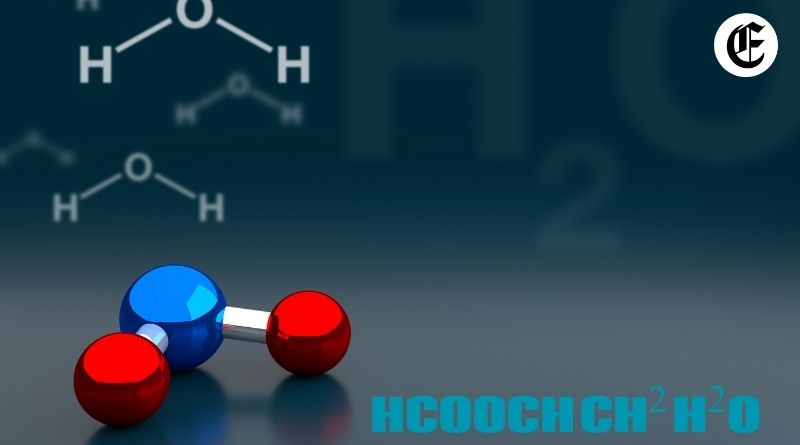
The chemical notation hcooch ch2 h2o might look cryptic at first glance, but it represents one of the most studied ester hydrolysis reactions in organic chemistry. This expression brings together methyl formate (HCOOCH3) and water (H2O), two seemingly simple compounds that interact in a fascinating way to produce formic acid and methanol. Understanding this reaction goes beyond academic curiosity. It plays a meaningful role in industrial chemistry, biochemistry, and even in everyday products like adhesives, refrigerants, and pharmaceuticals. In this article, we will dive deep into what this reaction means, how it proceeds, why it matters, and where you can find its applications in real life.
Understanding the Chemistry Behind the Reaction
At its core, hcooch ch2 h2o describes the hydrolysis of methyl formate. Hydrolysis is a chemical process in which water breaks the bonds of another compound, resulting in two or more new substances. When methyl formate reacts with water, the ester bond holding the formate group and the methyl group together is split apart. The products of this transformation are formic acid (HCOOH), the simplest carboxylic acid, and methanol (CH3OH), the simplest alcohol. The balanced reaction can be written as HCOOCH3 + H2O → HCOOH + CH3OH.
Although the equation looks straightforward, the underlying chemistry involves a delicate interplay of electron movement, bond breaking, and bond forming. The carbonyl carbon of the ester acts as an electrophilic center, while the oxygen of water serves as a nucleophile. This subtle dance of atoms is what makes ester hydrolysis a textbook example for students learning organic reaction mechanisms, and it is why chemists continue to study its finer details even today.
Breaking Down the Molecular Components
The Role of Methyl Formate
Methyl formate is a colorless, volatile liquid with a slightly fruity smell. It is one of the smallest esters known and is produced industrially by reacting methanol with carbon monoxide in the presence of a sodium methoxide catalyst. Beyond its role in hydrolysis reactions, methyl formate is widely used as a blowing agent for foam insulation, a solvent in cellulose acetate production, and an intermediate in the synthesis of formic acid and dimethylformamide. Its high vapor pressure and low boiling point of about 32 degrees Celsius make it convenient for many industrial processes but also demand careful storage and handling.
Water as the Reactive Partner
Water might seem like the most ordinary substance on Earth, but in this reaction it acts as the active agent that triggers chemical change. The slightly polar nature of water, with its partial positive hydrogen atoms and partial negative oxygen atom, allows it to attack the ester linkage of methyl formate. Under pure conditions, water alone reacts slowly with methyl formate, but the addition of an acid or a base can dramatically speed up the process. This catalytic boost is one of the reasons the reaction is studied so extensively in laboratories around the world.
The Reaction Mechanism Step by Step
Acid-Catalyzed Hydrolysis
When a small amount of strong acid such as hydrochloric acid or sulfuric acid is added, the reaction proceeds through several well-defined stages. First, the carbonyl oxygen of methyl formate gets protonated by the acid, which makes the carbonyl carbon more electrophilic and therefore more attractive to nucleophiles. Next, a water molecule attacks this activated carbon, forming a tetrahedral intermediate. Proton transfers then take place within this intermediate, converting the methoxy group into a better leaving group. Finally, methanol departs and formic acid is released, regenerating the acid catalyst. The acid is not consumed during the reaction, which is the defining feature of catalysis.
Base-Catalyzed Hydrolysis
The base-catalyzed version, often called saponification, proceeds through a slightly different pathway. Here, the hydroxide ion directly attacks the carbonyl carbon, bypassing the protonation step. The resulting tetrahedral intermediate collapses, expelling the methoxide ion, which then abstracts a proton to form methanol. The formate ion produced in this process is highly stable and does not easily revert back to methyl formate. This irreversibility makes base-catalyzed hydrolysis particularly useful when complete conversion of the starting material is desired in an industrial setting.
Industrial Applications and Importance
The significance of hcooch ch2 h2o extends well beyond the classroom. In the chemical industry, the hydrolysis of methyl formate is a major route for producing formic acid, which itself has countless uses. Formic acid serves as a preservative and antibacterial agent in livestock feed, a coagulant in rubber manufacturing, a finishing agent for textiles, and a reducing agent in leather tanning. It is also gaining attention as a potential hydrogen storage material for fuel cells, where it can release hydrogen gas under controlled conditions for clean energy applications.
Methanol, the other product of this reaction, is a feedstock for producing formaldehyde, acetic acid, methyl tert-butyl ether, and a wide range of plastics. Methanol is also being explored as a cleaner alternative fuel for ships and certain vehicles. By understanding and optimizing the hydrolysis of methyl formate, chemists can produce both of these valuable compounds efficiently and sustainably, reducing waste and improving the overall economics of chemical manufacturing.
Laboratory Significance and Educational Value
In academic settings, the reaction described by hcooch ch2 h2o is a popular subject in organic chemistry courses because it elegantly demonstrates several core concepts at once. Students learn about nucleophilic acyl substitution, catalysis, reaction equilibrium, and reaction kinetics, all within a single example. Laboratory experiments often involve measuring the rate of hydrolysis under different conditions, such as varying the pH, temperature, or concentration of reactants, to illustrate how external factors influence chemical reactions. These exercises build the foundational skills needed to understand more complex biochemical processes, such as the enzymatic breakdown of fats and proteins in living organisms.
Safety Considerations and Handling Precautions
While the products of this reaction are useful, the chemicals involved demand careful handling. Methyl formate is highly flammable and can form explosive mixtures with air, which is why storage tanks and reaction vessels must be kept away from heat sources and open flames. Inhalation of its vapors can cause irritation of the respiratory tract, dizziness, and in severe cases, damage to the central nervous system. Formic acid, while less volatile, is corrosive and can cause burns on contact with skin or eyes. Methanol is famously toxic if ingested, with even small amounts capable of causing blindness or death. Laboratories and industrial plants working with these substances must follow strict safety protocols, including the use of gloves, goggles, fume hoods, and proper ventilation systems.
Environmental Impact and Sustainability
As industries strive for greener processes, the reaction represented by hcooch ch2 h2o has drawn growing interest from sustainability researchers. Methyl formate can be synthesized from carbon dioxide and hydrogen, opening up the possibility of using captured greenhouse gases as raw materials. When this methyl formate is later hydrolyzed, the resulting formic acid can serve as a clean energy carrier that releases only carbon dioxide and water when used in fuel cells. Closing this carbon loop could play a role in reducing the carbon footprint of chemical manufacturing on a global scale. Research into catalysts that work with milder conditions, lower energy requirements, and water-based solvents continues to push this reaction toward a more environmentally friendly future.
Why This Reaction Matters in Modern Chemistry
The chemistry of hcooch ch2 h2o is not just a topic for textbooks. It connects organic chemistry to industrial production, environmental science, and even the future of renewable energy. The ability to break an ester bond using nothing more than water and a catalyst showcases the elegance of chemical reactions and the practical value they bring to society. Whether you are a student trying to grasp reaction mechanisms, a chemist looking for efficient synthesis routes, or simply someone curious about the science behind everyday products, this reaction offers a window into how the molecular world shapes the modern one we live in.
Final Thoughts
The expression hcooch ch2 h2o captures more than a chemical equation. It represents a process that has informed generations of chemistry teaching, supported industries that produce essentials ranging from leather to medicine, and inspired new directions in sustainable technology. By understanding the components, the mechanism, the applications, and the safety aspects of methyl formate hydrolysis, we gain insight into a reaction that is both fundamentally simple and remarkably important. As ongoing research continues to refine and reimagine this transformation, its role in chemistry and industry will likely grow even more significant in the years ahead.
Read Also: Entrepreneuradvices